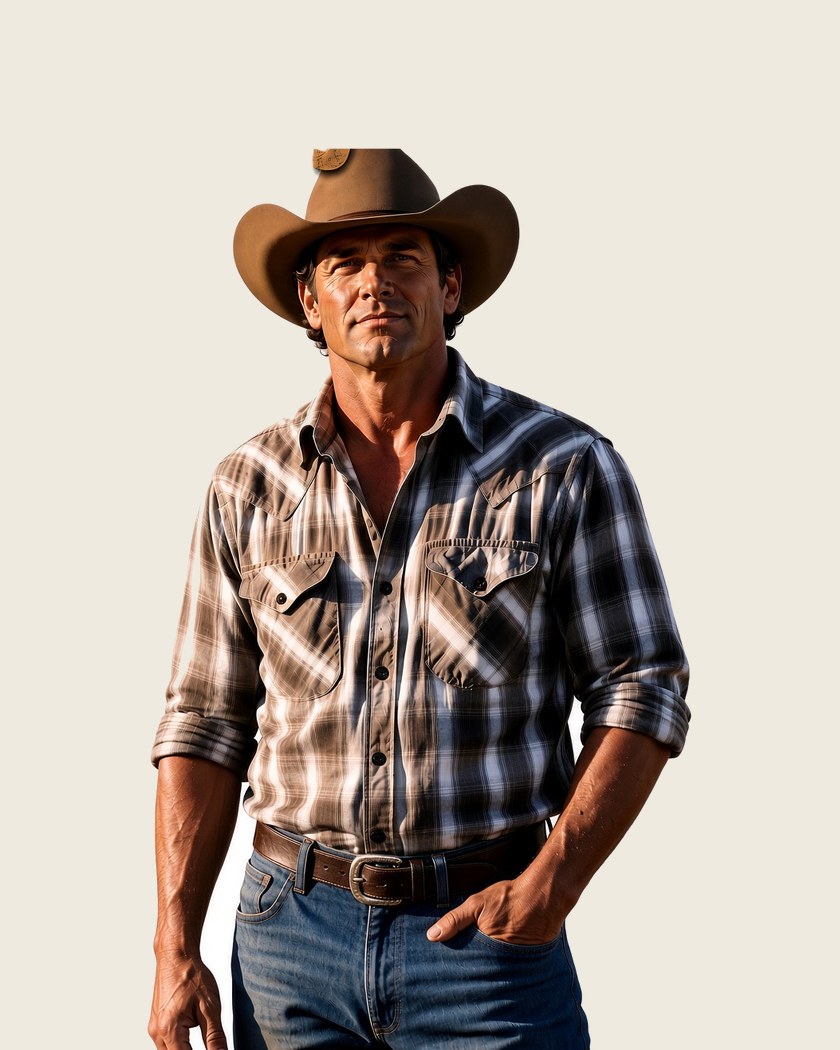
Henry Colter looks like a man who belongs exactly where he is
In the photographs, he stands beneath a broad Western sky with sage at his waist and dry hills falling away behind him. The sleeves of his plaid work shirt are rolled to the forearms. His cowboy hat is worn like part of the man rather than part of the wardrobe. There is no guitar strategically placed in the frame, no truck throwing ornamental dust, no bottle waiting on a fence post. Colter does not need the usual evidence
He comes from Montana’s Flathead region, where the mountains do not decorate the horizon so much as govern it. They decide what weather reaches you, how far you can see, and how small a man is willing to admit he might be. That country gave Colter the scale of his music: valleys wide enough for a choir, winter light quiet enough for a confession, and eagles rising on air no human being can see
But Montana is only half the map
After his parents divorced, Colter spent his summers in Sunset, South Carolina. The name sounds invented by a songwriter, but the contradiction was real: a boy pulled between the cold, enormous freedom of the Flathead and the thick green heat of the Carolina foothills. Montana taught him distance. South Carolina taught him longing. In one place, a person could disappear into the mountains. In the other, memory stayed close enough to sweat through a shirt
That divided childhood became the hidden geography of nearly everything Colter would later sing. His songs are crowded with roads because home was never only one place. They carry mountains and Southern gospel in the same breath because both were present before he knew what genre meant. Even his most peaceful songs contain movement, as though some part of him still expects summer to end and a car door to close
Colter calls his music Western country gospel. It is not a fashionable compound and it is not shorthand for country songs with a choir pasted onto the final chorus. The Western part is physical: gravel, timber, wildlife, fence lines, headlights, rivers, old trucks, work performed before sunrise. The gospel part is moral. It is the belief that nobody—not the drunk, not the addict, not the outcast, not the person a church has judged—is beyond the reach of love
That belief was not inherited without a fight
Colter is an alcoholic and an addict. He loved wine and whiskey. Beer was for the mornings, when drinking was no longer celebration or rebellion but maintenance—the first uneasy bargain of another day. He does not speak about addiction as a colorful chapter from the outlaw-country handbook. In his world, the romance ends quickly. The first drink may glow in memory; the last bad one tells the truth. Addiction is shaking hands, a motel blind leaking morning, a name that no longer sounds like your own, and the terrible discovery that a man can keep breathing after he has lost any reason he can identify for doing so
Recovery gave Colter his central subject, but not in the obvious way. His songs are not primarily about substances. They are about what human beings try to pour into spaces that cannot be filled: applause, work, sex, motion, anger, money, righteousness, another town, another lover, another promise that tomorrow will somehow ask less of us
Colter’s answer is neither polished nor easy. Surrender, in his music, is not defeat. Grace is not the cancellation of consequences. Some people forgive you. Some do not. Some bridges can be rebuilt. Others remain blackened on the horizon, and the best a man can do is stop setting fire to roads
That is where Colter’s masculinity lives—not in domination, but in responsibility. He will sing about a man holding a door a little longer, helping an old woman, washing his own car by hand, keeping his word, and admitting when he is wrong. He can be crude, funny, lustful, furious, frightened, and stubborn. But cruelty is never offered as proof of strength. In Colter’s moral universe, a man is strongest when somebody weaker is safe beside him
His faith follows the same rule
Colter’s God is not a bouncer posted at the church door. He is the presence that remains in the room after everybody respectable has left. Every person is God’s child in these songs, regardless of sexuality, addiction, history, or way of life. Colter does not pretend that belief resolves every argument. He simply refuses to let religion become an excuse for abandonment
This is why his darkest songs rarely end in total darkness. They may not offer rescue. They may offer only one more sunrise, one unanswered phone call to the old devil, one hand held through the night, or one damaged person deciding not to disappear. For Colter, hope does not have to be large to be holy
His heroes explain the rest of him
Johnny Cash gave Colter a model for moral gravity: the ability to stand among prisoners, sinners, believers, and broken men without singing down to them. Bob Seger gave him the road—not the postcard highway, but the long nocturnal stretch where a saxophone can sound like loneliness itself. Barry White showed him that a deep voice could carry tenderness and desire without surrendering authority. And Betty White, the outlier who makes perfect sense once you understand Colter, embodied the combination he values most: longevity, timing, warmth, wicked humor, and an instinctive affection for living creatures
Put those four names together and Henry Colter begins to come into focus. Cash is his conscience. Seger is his highway. Barry White is the midnight warmth in his voice. Betty White is the grin that keeps the whole enterprise from becoming unbearably solemn
Then there are the circus people
Colter is afraid of them
He knows how it sounds. A man comfortable beneath a sky split open by thunder, a recovering addict willing to sing plainly about death, God, and the wreckage of his own life—and somewhere inside him, the arrival of circus performers still wakes an old and irrational alarm. He does not turn the fear into contempt. If anything, its absurdity appeals to him. It is proof that courage is not the absence of fear and that the human mind does not organize its terrors according to dignity
The detail matters because Colter would be insufferable if he were only myth. The fear makes him peculiar. Betty White makes him funny. Barry White makes him sensual. South Carolina complicates Montana. Addiction complicates faith. His tenderness complicates the hat, the boots, and the baritone
The animals matter too
In Colter’s songs, bald eagles, osprey, great blue herons, elk, mule deer, whitetails, magpies, bison, and foxes are not symbols dragged onstage to certify his Western authenticity. They are witnesses. The eagle does not exist to tell Henry he is free. It rises because rising is what the wind allows, and the sight of it forces the man below to reconsider his place in creation
Colter is careful about the land for the same reason. His Montana is not an empty kingdom awaiting possession. The Blackfeet and other Indigenous peoples were present long before highways divided the plains or towns received their names. The land remembers lives and stories beyond his own. A man can love the West completely and still understand that loving something does not make it his
That humility separates Colter from the costume version of country music. His songs may contain flags, soldiers, horses, rifles, trucks, cattle, hard work, whiskey memories, and men trying not to cry. But the objects never substitute for a point of view. Patriotism must be strong enough to remember the whole history. Faith must be strong enough to survive questions. Manhood must be strong enough to apologize. A recovery song must remember the people who did not survive
Musically, Colter favors wood, wire, breath, and room sound. Acoustic guitar forms the spine. Pedal steel carries distance. Fiddle can burn or grieve. Piano makes a confession feel close enough to overhear. Organ and choir arrive only when the song has earned the sky opening above it. A lonely saxophone sometimes appears at the edge of the arrangement, carrying Seger’s midnight road into Flathead country
The voice remains the center: a deep, weathered baritone that sounds less interested in impressing a room than in reaching the one person at the back who has stopped believing the song is meant for them
Colter’s writing follows an equally unforgiving standard. Plainspoken does not mean simple-minded. He wants the physical truth first: the motel blind, the shaking hand, the old screen door, the cup of coffee, the gravel under a tire, the bird holding still at the shoreline. The spiritual meaning can enter later. If God belongs in the song, He will not need to be stapled to the chorus
That method has made Henry Colter something stranger and more necessary than a revivalist cowboy act. He is a character built from American contradictions: Northern and Southern, sacred and profane, wounded and useful, solitary and desperate for connection. He sings about freedom while understanding that freedom without responsibility becomes another form of running away
The roads in Colter’s songs stretch through Montana, South Carolina, Wyoming, Kansas, Oklahoma, and all the unnamed places between regret and return. Sometimes the man behind the wheel is escaping. Sometimes he is going home. Most often, he has not yet learned the difference
And perhaps that is the secret of Henry Colter. He is not presented as healed. He is presented as healing
There is a profound difference
A healed man can become a monument. A healing man can still sit beside you. He can tell you that he misses the lie of the first drink but remembers the truth of the last one. He can confess that some nights peace arrives only after the pain goes numb. He can believe in God while admitting how often he tried to fill a God-sized absence with everything else. He can be afraid of circus people and still walk into the darkest room in town
Henry Colter does not promise that everybody gets back what they lost. He does not promise that every family reunites, every wound closes, every prayer is answered in the form requested, or every road leads home
He promises something smaller, rougher, and perhaps more believable
Nobody has to walk that road unloved
That is the gospel in Henry Colter’s Western country gospel. Not perfection. Not performance. Presence
Forever cowboy
Singer of the ages